The following article was contributed by Leah Lane, aka Electricmayhempins on Instagram. Thank you Leah for an insightful and informative exploration of the Muppets!

This past week, millions of people joined the “No Kings Protest” to denounce the authoritarian policies of Donald Trump and the corruption within his administration. Many members of the Muppet fan community posted in support, or even took to the streets themselves, to stand in solidarity. It was an incredible show of unity and shared values, but it didn’t come without backlash.
Several fans flooded the comments, accusing the community of “politicizing” the Muppets. “Nobody cares Keep it to yourself nobody wants an attitude like this keep politics out of the muppets!” (direct quote from a Facebook comment). Comments like this are what ultimately compelled me to write this piece.
Because here’s the thing: anyone who believes the Muppets, and the countless projects created by Jim Henson and his collaborators, are not political simply hasn’t been paying attention. The Muppets have always been political. The very existence of Sesame Street is a political act. To claim otherwise is to ignore decades of intentional storytelling, cultural commentary, and, frankly, basic media literacy.
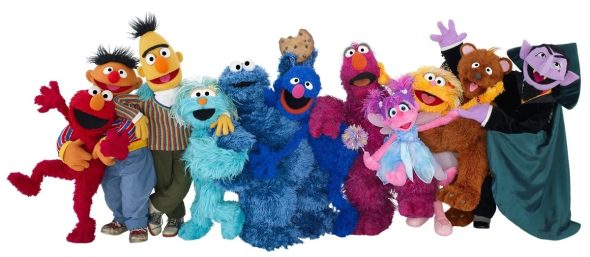
The Politics of Sesame Street
From its inception, Sesame Street was designed to close the racial and educational gap for children in urban areas, explicitly a civil rights project. Co-created with input from the U.S. Office of Education and Black educators and activists, it wasn’t just a television show; it was a public investment in equity.
Marilyn Agrelo, director of the documentary Street Gang: How We Got to Sesame Street, put it perfectly: “The people that started the show were intent on harnessing all of the energy that was around the protests of the Vietnam War, the civil rights movement. They wanted to explain the world to children, but their bigger goal was to reach inner-city children of color who were not getting the same educational opportunities as white children in the suburbs.”
That mission was radical enough to make some people uncomfortable. In May 1970, Mississippi’s state educational television commission voted to ban Sesame Street because of its integrated cast – Black and white children and adults interacting as equals. One commissioner stated that Mississippi was “not yet ready” for such content. The decision was reversed after 22 days of national outrage, but it underscored how deeply political Sesame Street’s very existence was. If it debuted today, the Trump organization would likely label it “woke DEI propaganda.”
Conservatives have long targeted PBS and the Corporation for Public Broadcasting, accusing shows like Sesame Street of “leftist bias,” most notably during the Nixon and Reagan eras, and again in the Trump years. Yet the show’s work speaks for itself. Sesame Workshop has intentionally chosen locations facing social and political turmoil – post–Cold War Russia, Ukraine, and the Middle East – not by chance, but as a deliberate effort to use media as a tool for social change. Programs like Ahlan Simsim expand access to education and emotional literacy for children living in conflict zones across the Middle East. By bringing educational resources directly to children who are most marginalized and vulnerable, the workshop turns its storytelling into a political act, demonstrating that education, empathy, and equity are inseparable from the real-world contexts in which children live.
In recent years, Sesame Street has continued that legacy at home by celebrating Pride, introducing diverse families, and creating characters like Wes and Elijah to engage directly with race and anti-racism education. When Big Bird got his COVID vaccine, it wasn’t partisan propaganda; it was a lesson in civic responsibility and care for others, while also comforting children who might be afraid. Even Bert and Ernie, whether seen as romantic partners or simply chosen family, embody the quiet radicalism of normalizing nontraditional relationships. Beyond representation, the show continues to tackle difficult real-world topics – incarceration, homelessness, addiction, grief, and military families – to teach children empathy, resilience, and social awareness. By addressing these issues openly, Sesame Street demonstrates that educating the heart is inseparable from educating the mind; its lessons are inherently political because they reflect the lives, struggles, and values of the society it seeks to serve.

Satire, Power, and the Muppet Legacy
While Sesame Street educates, the core Muppets have always wielded humor as a weapon, poking fun at the powerful, celebrating the underdogs, and turning the absurdities of society into sharp, unforgettable satire. Villains like Tex Richman and Doc Hopper are caricatures of capitalist greed. The heroes, by contrast, are artists, dreamers, and outsiders who succeed through collaboration, creativity, and heart.
This satirical impulse was evident from the very beginning. One of Jim Henson’s earliest television projects, The Muppet Show: Sex and Violence, was a short-lived sketch show explicitly designed to push boundaries. Though it never became a full series, the program lampooned authority, critiqued social norms, and explored themes of morality, greed, and human folly. It was a bold declaration: the Muppets were never going to be safe, neutral, or apolitical. From the start, Henson’s work combined humor with pointed social commentary, setting the stage for decades of satire to come.
That early experiment set the tone for everything that followed. The Muppet Show may have looked like lighthearted variety entertainment, but beneath the musical numbers and slapstick, it carried forward that same sharp edge – poking fun at hypocrisy, pomposity, and power itself. Even characters like Sam the Eagle, a self-serious embodiment of conservative moral panic, function as self-aware satire – a send-up of “values guardians” who miss the point entirely. You could say that Sam the Eagle was an early version of The Colbert Report.
My fiancé’s favorite Muppet sketch illustrates this perfectly: Sam Eagle takes the stage to give his opinions on “the glories of industry and technology.” He begins by critiquing a “small subversive group of NAMBY-PAMBY conservationists” who want to stop “the march of progress for the sake of a few insignificant animals.” He goes on to list the supposedly insignificant species these “weirdos” want to protect – mountain lions, alligators, coyotes, timber wolves, only stopping once he realizes that American bald eagles (himself) are on the endangered species list. Upon realizing that industrial progress could personally harm him, he immediately declares, “This list is now inoperative.”
That last line is a direct reference to Richard Nixon’s press secretary, Ron Ziegler, who in 1973 said, “This is the operative statement. The others are inoperative,” in reference to the Watergate scandal. The Muppets aren’t just generally critiquing conservatives who backtrack when legislation negatively affects them – they’re doing so directly by lifting a well-known phrase from Ziegler himself, turning political satire into sharp, layered comedy.
When the 2011 Muppets film was released, conservative commentators like Eric Bolling and Andrea Tantaros accused it of “brainwashing kids against capitalism.” The villain in The Muppets is Tex Richman, an oilman who wants to tear down the Muppets theater to drill for oil underneath. The topic was debated on FOX’s Follow the Money, with a network host and two commentators saying Big Oil wasn’t being treated fairly. The outrage itself became proof that the Muppets’ values – kindness over greed, community over profit – still carried political weight.
Even today, the Muppets continue to push boundaries. In a recent episode of the animated Muppet Babies reboot, Gonzo explores gender and self-expression. When the Muppet babies get ready for a dance, Gonzo is disappointed to learn that only the girls can wear princess dresses while the boys must be knights. Undeterred, he secretly attends the ball as a masked princess, concealing his identity. When the other Muppets express disappointment that he missed the ball, Gonzo reveals that he was, in fact, the princess… Gonzorella. He tells them, “You all expected me to look a certain way. I don’t want you to be upset with me. But I don’t want to do things just because that’s the way they’ve always been done either. I want to be me.” This episode faced massive backlash from conservatives, with conservative commentator Candace Owens tweeting, “I can’t believe I’m tweeting this but.. they are pushing the trans agenda on children via muppet babies. This is sick and PERVERTED. Everyone should be disturbed by predatory cartoons meant to usher children into gender dysphoria. Bring back manly muppets, anyone?”
The Muppets have never shied away from satire, social commentary, or moral critique. They are anti-authoritarian and environmentally conscious, and they boldly explore gender and identity, all while exposing greed and hypocrisy. These values remain as political today as they were in the 1970s – not because they take sides, but because they reflect the world, question its inequities, and encourage audiences to imagine a fairer, kinder society.
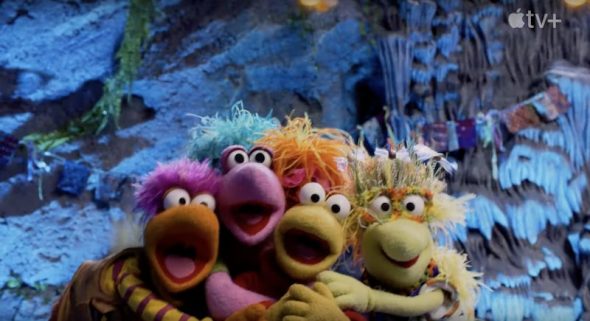
Fraggle Rock and Henson’s Utopian Vision
If Sesame Street was civic, and the Muppets were satirical, Fraggle Rock was utopian. Jim Henson described the show’s goal as simple but radical: “to bring peace to the world.” Each group in the show – the Fraggles, the Doozers, and the Gorgs – represented different social and economic systems, learning to coexist through understanding and balance.
“By seeing how the various groups in the world of Fraggle Rock learn to deal with their differences,” Jim Henson explained, “perhaps we can learn a little bit about how to deal with ours.”
The show’s international co-productions in the U.S. and Canada, the U.K., France, and Germany reflected Henson’s belief that media could bridge cultures and foster empathy. Even that idealism, creating television about cooperation, ecology, and peace, was inherently political.
I could go on to list all the ways Fraggle Rock was created with the intention of global peace, but Julia Gaskill already did a phenomenal job writing about it in her essay “Fraggle Woke.” Seriously – go read it, and come back when you’re done.
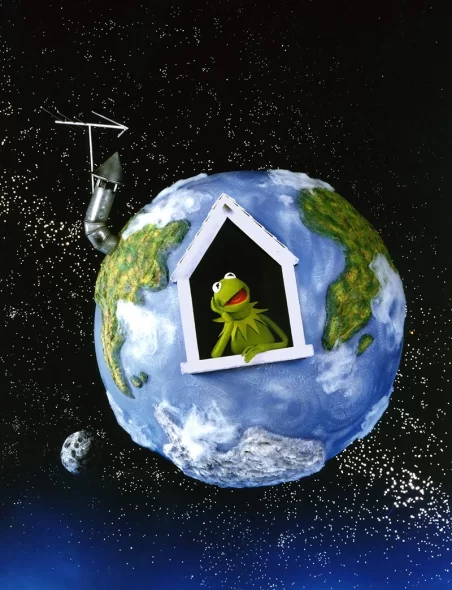
The Heart of It All
To be clear, I’m not arguing that the Muppets are partisan mouthpieces for the left (even if I might want them to be, lol). Their stories are also rooted in values that resonate deeply with conservative audiences: self-reliance, tradition, civility, and patriotism. Jim Henson’s world values personal responsibility as much as collective care.
Jim was quoted in the book “It’s Not Easy Being Green” as saying, “When I was young, my ambition was to be one of the people who made a difference in this world. My hope is to leave the world a little better for having been there.” Making the world better isn’t done by “staying out of politics,” and this is something Jim understood. No, he never ran for office. But with even a basic sense of media literacy, it’s clear that he used his storytelling to make a difference. Being political doesn’t require holding office – or even wearing an “I voted” sticker.
One comment in particular stood out to me: “Some things CAN be reserved for escape and to simply find joy in.” This interpretation completely misses everything the Muppets were ever about. The Muppets were never intended to be escapist. The very fact that they exist as physical beings in our world rejects escapism entirely. Sesame Street is explicitly set in New York, not some mythical place. The Muppets travel to London, Russia, and Manhattan, very real locations. Even Fraggle Rock is connected to our world. The Muppets are grounded in reality and were always created to reflect it.
No, the Muppets aren’t blue or red, but they ARE felt-and-foam reminders that decency, humor, and humanity can coexist across divides. That tension, the ability to embody both personal responsibility and collective compassion, is precisely what gives them their staying power. The Muppets are a reflection of our world, and our world is inherently political. To think otherwise isn’t just naïve; it’s a complete misread of what the Muppets have always stood for.
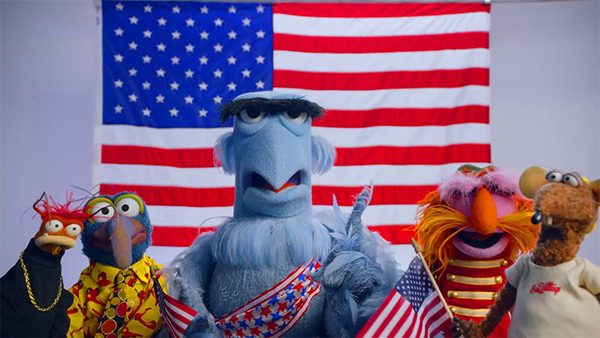
Click here to stand for the ToughPigs Discord national anthem!
by Leah Lane – @electricmayhempins on Instagram