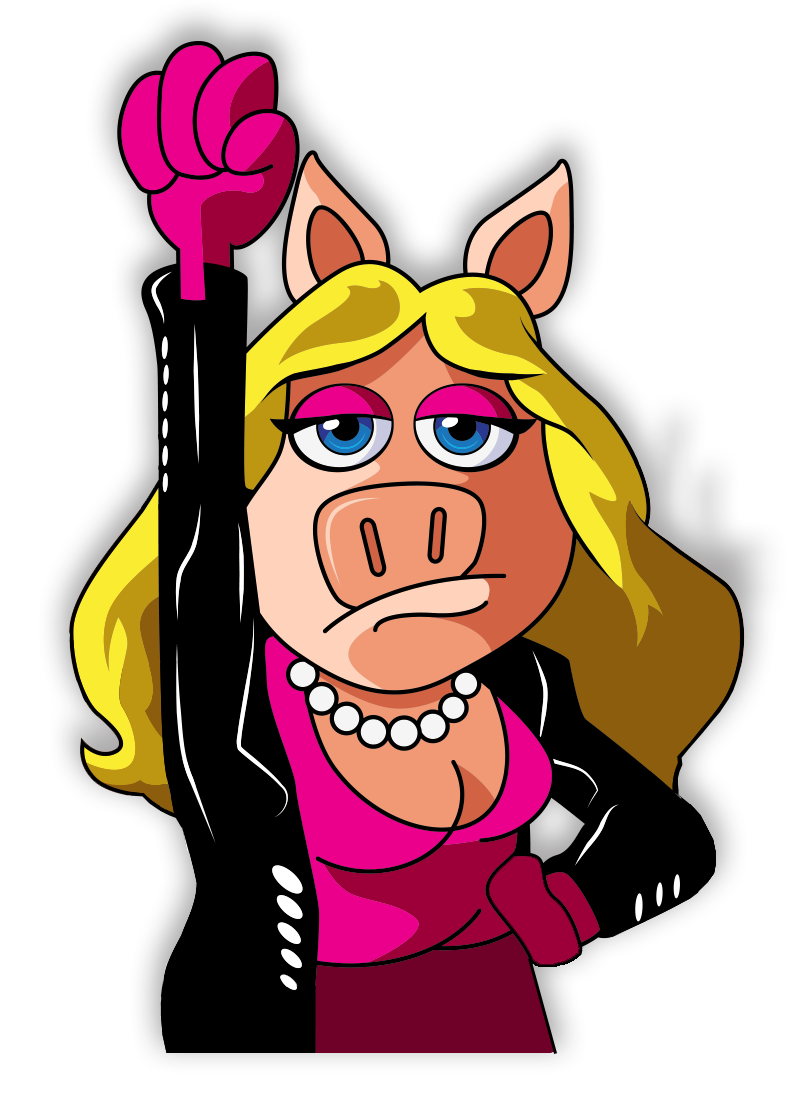
The following was written December 12th, the morning after Miss Piggy and Rowlf performed at The Game Awards.
I just woke up in a fog after an unusually long sleep filled with bad dreams. I got out of bed, turned on the light, winced at the light, and grabbed my phone to check my messages. Naturally I bumped into the footage of the latest Muppet appearance at the Game Awards. It’s not something I was particularly interested in watching until I saw who was in it. Instead of something straightforward like Animal or Scooter, we got a number at the piano with Miss Piggy and Rowlf. Yes, my boy Rowlf, at the piano, where he belongs. Huh.
The Game Awards appearance warrants our attention as Muppet fans for a few reasons, most of which stem from the fact that it gave Miss Piggy a few minutes to do bits without Kermit.
Astonishingly, she implied that she had a fling with the host. That’s a risky thing to do these days – sometimes the masses get angry when you suggest she and Kermit haven’t been going steady since our nation’s founding. The host didn’t know how to play into that, but it was nevertheless a welcome throwback to Piggy appearances from her heyday.
The second beat with Piggy just let her flip out, not in a karate chopping way, but in a genuinely emotional way. It was no Jay Leno New Year’s bit, but what is?
I watched all three Muppet moments in the broadcast, but the song really struck me. It wasn’t a song I’d heard before. I think they wrote it just for this. And it wasn’t like the music you typically hear in puppet productions these days – no trace of the bland sound that some of us fans think of as “Secular Christian Rock”. This was somewhere between ragtime, vaudeville, British music hall, Tin Pan Alley, and Broadway. It’s Muppet core.
I was impressed! But then the song reached the end, and I gasped. This song was not just Muppet core, or Muppety, or even Muppetational. This was a new, genuine, true blue Muppet Number. And it has renewed my hope for The Muppets.
What do I mean by “Muppet Number”? Well, that’s what I’m trying to work out by writing about it. I know I don’t just mean a great song, or even a great performance of a great song. I’m trying to determine the ways that a song can feel connected to the best of the classic Muppet songs and embody the Muppet brand as we know it. It’s not an exact criteria in which following a set of rules to a T wins a song admittance – it’s more like family resemblance, or a musical tradition or genre.
I think the last time The Muppets performed a Muppet Number was in 2012. There are songs that come close in Muppets Most Wanted – “I’m Number One” and, right on the borderline, “We’re Doin’ a Sequel” – and I love them both. You can also make the case for “Life Hereafter”, despite its tonal and lyrical awkwardness. What happened in 2012, however, was a horse of a different color… or, as it were, of a different country.
The Muppets performed in the Just for Laughs festival in Montreal, not merely to make appearances, but as the hosts for the evening, and the stand-ups were effectively their guests. That makes it sound more like The Muppet Show than it was, but what it was was good. There’s a great routine about what they think of the Swedish Chef in Sweden, which is a highlight of the show despite Muppets not being very much involved in it. Its truly great Muppet moment, however, is a genuine Muppet Number called “Canada Is”.
“Canada Is” is a class Muppet ensemble piece. Rather than doing an old showtune, they opt for another classic Muppet genre: an anthem. Several Muppets, each taking a turn, sing a fact about what Canada is. All of their facts are wrong. When Kermit asks where they got their information from, Sam the Eagle proudly replies, “From Americans.” There are a few things about it that stand out.
1. It’s funny.
Not just silly, but truly, laugh-out-loud funny. Part of that’s just because it’s saying a bunch of false things that disparage a whole nation, and part of it’s the fact that they’re doing that in said nation, which are very particular circumstances that I can’t expect The Muppets to repeat all the time. The essential part of it that can be repeated, and that applies to classic Muppet moments like “Mah Na Mah Na”, is that it’s kind of a prank on the audience, but it’s not a dig at them – it’s The Muppets who come out of it as the butt of the joke.
In the old days, The Muppets rarely sang a song for the sake of Muppets singing. Musically, almost any song would be better served better by having humans who are actual singers sing it than by Muppets with goofy voices, if not for the fact that Muppets performed songs with intention. Sometimes that intention was showcasing a spectacle, sometimes it was moving a story forward, sometimes it was connecting us to a character, and sometimes it was making us cry. Muppet Numbers, and most good Muppet musical moments generally, are trying to do something, and that something is most often making us laugh.

2. It creates conflict that has narrative momentum.
There are a few examples of Muppet Numbers that are not ensemble pieces, but most of them have this quality. Consider “I Refuse to Sing Along” (Bert vs. Ernie), “Fever” (Rita Moreno vs. Animal), “It’s Not Where You Start” (Rowlf vs. time), or “I Can’t Believe I’m Hosting SNL” (Jason Segel vs. The Muppets). Sometimes, if it’s an original song, the conflict is there in the lyrics, such as “The Rhyming Song”. Just about any juxtaposition will do, even if its conflict isn’t between two characters – it can come from a lyrical mismatch, or even something wrong with the set.
A practically perfect example of a Muppet Number is “Another Opening, Another Show”. The lyrics mention the stagehands saying hello, and that’s when Beaker and Beauregard drop the ropes for the curtains to wave. Curtains and backdrops begin to fall, one after another after another, and the Muppet ensemble has to fight their way past them to the front of a seemingly endless stage. This exemplifies something that can make or break a Muppet musical number…
3. It establishes The Muppets’ collective personality.
They are failures, making an absolute mess, but they keep on trying and they do it together, which is enough to make them a success where it counts. That’s a special kind of feel-good quality that can turn just about any Muppet ensemble piece, whether it’s upbeat like “Another Opening, Another Show” or gentle like “Just One Person”. It’s heartfelt without being maudlin and ridiculous without being hurtful.
4. It demonstrates a love for the way The Muppets sing.
There are many ways a number can show this. “Rainbow Connection” is written the way Kermit naturally talks. There are specific Muppet flourishes that hardly anybody else would bring to a song, like the argumentative dialogue at the beginning of Gonzo and Rizzo’s “It’s the Most Wonderful Time of the Year”, or the “Ba Dum Dum Dum” in “Twelve Days of Christmas”, or whenever a character yells “Modulate!”
Ideally, Muppet voices are presented without autotune or overcompression – the voices are allowed to be what they are, warts and all. No drowning them out with instruments, no overproduction (unless that’s the joke, of course).
For good measure, I recommend some simple puppet choreography to keep the number visually interesting, rooted in an appreciation for the way puppets move to music – swaying does the job just fine.
Crucially, most classic Muppet music that has multiple characters effectively employs harmonies. Like, in the literal sense. The music term. The Muppets are a chorus. You hear this all throughout Fraggle Rock. You hear it in Emmet Otter and A Christmas Together. You hear it in The Muppet Show Theme. You hear it in the moments when The Muppet Show is stating what The Muppets are all about, like “Just One Person” and the definitive Muppet Number, “We Got Us.”
Of course, for as much as they employ harmony literally, they do so in a way that represents its colloquial meaning. It is a philosophical statement – a belief that people are at their best when they come together, not to do the exact same thing or be the exact same way, but to be different in ways that support the whole group.
“Canada Is” presented to the audience a song that was too old-fashioned and unpolished to ever be a popular hit – even if the song had been written as a sincere piece with no attempt at comedy, only The Muppets would do something that old-hat so earnestly. They’re old souls. They have come together to sing and dance in harmony, and it just feels nice. I don’t know what it is that makes some Muppet songs capture the sound of the family coming together in a way others don’t – The Muppets singing a melancholy “Hooray for Hollywood” scratches that itch for me even without much (if any) harmonizing, while a modern-day, highly harmonic Fraggle song doesn’t do it for me – but “Canada Is” captured it.
Finally, we get to the number. It’s Rowlf at the piano, plink-planking a melody that feels a hundred years old. Good. Piggy is upset because they didn’t get to rehearse, as Muppets shouldn’t. Rowlf suggests they just start singing something and figure it out on the way. Very Muppets! As he does, Piggy argues that it won’t work, but they find that she’s doing so rhythmically, and is therefore actually performing the song she says she won’t sing. Sound familiar?
At this point, it already kind of feels like we’re back. Rowlf lists several video game titles in his song and cracks a joke or two that are just for the gamers, which is the sort of audience-specific humor that reminds me of “Canada Is”.
This piece loves the kinds of songs The Muppets do and just lets them sing it without much production. It captures the feel-good quality of making the best of a mess. It has an inherent conflict that leads to a satisfying narrative conclusion. It’s also funny! And then, the big finish….
By gosh. They did it. I don’t know how they read my mind. I don’t know how they knew the thing I’d been wishing for The Muppets to do but never put into words. They actually finished a number the Muppet way – the “We Got Us” way. They sing like they’re on a rollercoaster – in a good way, not in a “why are they taking The Muppets out of a theater and putting them in a thrill ride to replace Aerosmith” sort of way. The melody bounces up and down until it crashes, which is exactly what The Muppets are supposed to feel like.
“We Got Us” is the song The Muppets sang before The Queen. In that version, Kermit follows the titular line with “unfortunately”, capturing how Kermit felt about his friends employees at the time, and yet, it still manages to be a feel-good anthem of togetherness. It’s the best version of what we choose to believe The Muppets are all about.
I recognize that there are only so many times you can do the “We Got Us” ending or the “Canada Is” ending. But “so many times” is a lot of times. I hope they do this a lot of times.
I’m sure my feelings about this are influenced by the particular Muppet projects I grew up with, so they may not be relevant to anyone else. The Muppet stuff I grew up with after Sesame and Bear was primarily the John Denver Christmas album, which is largely in line with the music I’ve described above, and the “Bein’ Green” sing-along tape, which opens with a jaunty, jazzy theme and closes with the friendly ensemble piece “Sweet Vacation”.
Nevertheless, I think this Game Awards number found something at the core of The Muppets that has been asleep for too long and woke it up. If this is any signal of what they’ll be trying to do throughout 2026, we have reason to be hopeful. We’re back. Us is here.

Click here to join the ensemble on the ToughPigs Discord!
By J.D. Hansel